
Walling in Wakefield: garden walls and retaining walls
Brick and natural stone, from a low wall round a front garden to a retaining wall holding a whole level of a sloping garden up. Both are built off a proper footing, and one of them has to deal with water as well.
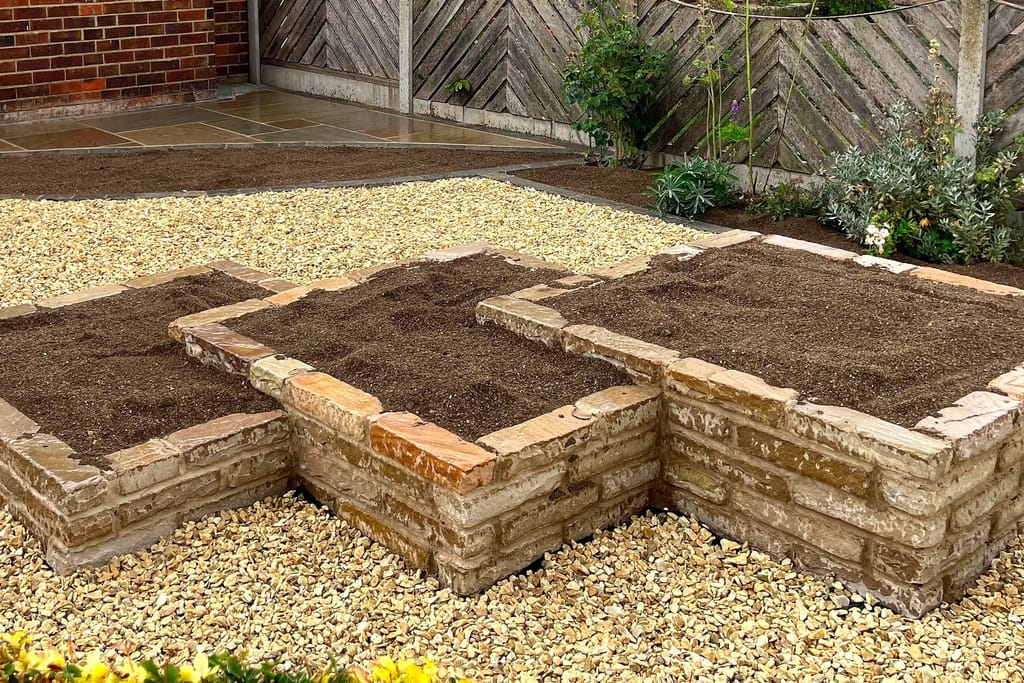
It starts below the ground
Every wall we build stands on a concrete footing dug down past the soft ground and past the reach of the frost, wider than the wall so the load spreads out. That sounds obvious and it is, but a wall that has cracked in a stepped line up through the joints, or leaned out over a few winters, has almost always been stood on a scrape and a bit of concrete. Below ground level the brickwork changes too, because ordinary facing brick is not made to sit in wet soil. Get those two things right and the rest of the wall is bricklaying.
Retaining walls are a different animal
A garden wall only has to hold itself up. A retaining wall has a bank leaning on it, and the load goes up sharply once that bank is wet through, which around here it will be. So a retaining wall is built heavier, sometimes thicker or with piers built into it, and it gets a drainage layer behind the face: clean stone against the back of the wall, a membrane so the soil cannot silt it up, and weep holes or a land drain giving the water somewhere to go. Without that, water builds up behind the wall over a wet winter and pushes it out, which is why so many old ones lean.
On a sloping garden a retaining wall is usually the thing that makes everything else possible. Cut the slope into two usable levels, hold the change with a wall, and you get a flat patio at the top and a lawn below instead of a bank nobody uses. That is a lot of the work we do, and the wall, the steps between the levels and the patio want designing together rather than one at a time.
Matching the house
The wall that looks right is the one that looks like it has always been there. That is less about finding an identical brick than about the mortar and the joint. Sand from the wrong pit gives you a mortar that reads pink or grey against the existing pointing and the eye goes straight to it, and a bucket handle joint next to a weather struck one looks wrong even if the brick is perfect. We take a sample or a photograph to the merchant, mix to match rather than to habit, and strike the joint the way the house is struck. On older stone property we will talk to you about a lime mortar rather than a hard cement one, because a hard mix on soft stone does the stone no favours.
Stone walling
Coursed sandstone laid in even beds is what most people picture, and it suits Yorkshire houses because it is what half of them are built from. Random walling and rubble work read older and looser. Either way the rules are the same as brick: build off a footing, keep the joints broken so nothing runs straight up through the face, and finish the top properly, whether that is stone copings, a rounded coping or a flat course. A tidy top course is the difference between a stone wall that looks built and one that looks stacked.
The small walls that make a garden work
Not every job is a big structure. A lot of what we do is low: a raised bed round a patio so you are not planting at ankle height, a border wall down the side of a house, a wall round a bin store, a low front garden wall rebuilt after a car has caught the corner of it. Small walls are quick, they are the cheapest way to make an outside space feel finished, and they are worth building properly for exactly the same reasons as a big one.
Questions we get asked about this
Can you match the brick on our house?
Usually we can get very close, and on a lot of jobs that is exactly what people want, a wall that reads as though it came with the house. We take a sample brick or a good photograph to the merchant and work from that. The honest bit is this: a brand new brick next to eighty years of Yorkshire weather never matches on day one, it matches after a few years. The two things that get you closest fastest are the mortar and the joint. Get the sand and the mix right so the colour of the mortar sits with the existing pointing, strike the joint the same way it is struck on the house, and most people stop noticing the brick. Where a genuine match matters more than the money, reclaimed brick is worth pricing.
Does a retaining wall really need drainage behind it?
Yes, and it is the thing that fails the ones you see leaning. A retaining wall is not holding back soil so much as holding back wet soil, and saturated ground pushes far harder than dry ground does. So behind ours there is clean stone against the back of the wall, a membrane so the soil cannot wash into it and block it up, and a route out for the water, either weep holes through the face or a land drain taking it to somewhere sensible. It is all buried and none of it shows in the finished photograph, which is precisely why it gets left out. If a price for a retaining wall looks light compared with the others, that is usually where the difference went.
How high can we build before we need permission?
As a rule of thumb, a boundary wall alongside a road or footpath is limited to a lower height than one round the back, and once you go above the limit it needs a planning application. There is also the case where a wall is holding a bank up or is a structure supporting something, and that is a building control question rather than a planning one. Rather than quote you numbers off a website, we check the current position with Wakefield Council before we price the job. If you share a boundary with a neighbour it is also worth a conversation with them early, because a wall on the line is much easier to build with everyone on side.
What customers say
-
5 out of 5 stars
5 * We can’t recommend Mark and Anthony enough. They spent 4 weeks completing a new retaining garden wall, incorporating curved steps, LED wall lighting and lower patio area finished in Indian stone. The results are fantastic. Both Mark and Anthony were very professional, polite and incredibly hard working. They kept us well informed throughout the work and were curtious and respectful to our neighbours. We are so pleased with the results and looking forward to enjoying the great social space they’ve created.
Damian ArmitageJuly 2025
-
5 out of 5 stars
Mark was very professional from start to finish. Mark and his colleague had a big job restructuring our garden - adding fencing, building raised walls and leveling the garden to two levels. Mark was very knowledgeable and was able to design a garden space that we love which wouldn't have been possible without his fantastic knowledge! The quality of the work was brilliant and himself and his colleague worked very hard from start to finish and always worked in a tidy work space. We are so happy with the result and would highly recommend Hemsley Building Services
Harriet WillsApril 2021
Read all 25 reviews, every one five stars on Google.
Ask for a free quote
A few quick questions, then we come out and measure up. You get a full quotation in writing, and no deposit is required.
⏱ Takes about 60 seconds.
17% complete
What do you need doing?
Pick the closest match. We can change it at the survey.
What is the job?
This tells us how much digging out to allow for.
Roughly how big?
An estimate is fine. We measure properly at the survey.
When would you like it done?
Honest answers help us book realistically. Spring and summer fill up first.
Where is the job?
Your postcode tells us whether it is on our patch and how far the muck away run is.
Got a photo of the spot? (optional)
One shot of the drive or garden as it is now saves us guessing.
📷 Used only to price your job. Never posted anywhere.
Where can we reach you?
We will get back to you by phone or email, your choice.
Got it.
We will be in touch to arrange the free site survey.
We have sent a copy of your enquiry to .
- Surface
- Job
- Size
- Timing
- Postcode
Next step is a site visit and a written quote. No deposit is taken at any point before you accept it.
While you wait, have a look at:
Get a price for your wall
Send us a photograph of the wall or the bank and tell us the postcode. We will come out, look at the ground and the levels, and put a price in writing with no deposit asked for. A family owned firm rated 5.0 on Google from 25 reviews.